US economics, inflation, jobs and the Fed
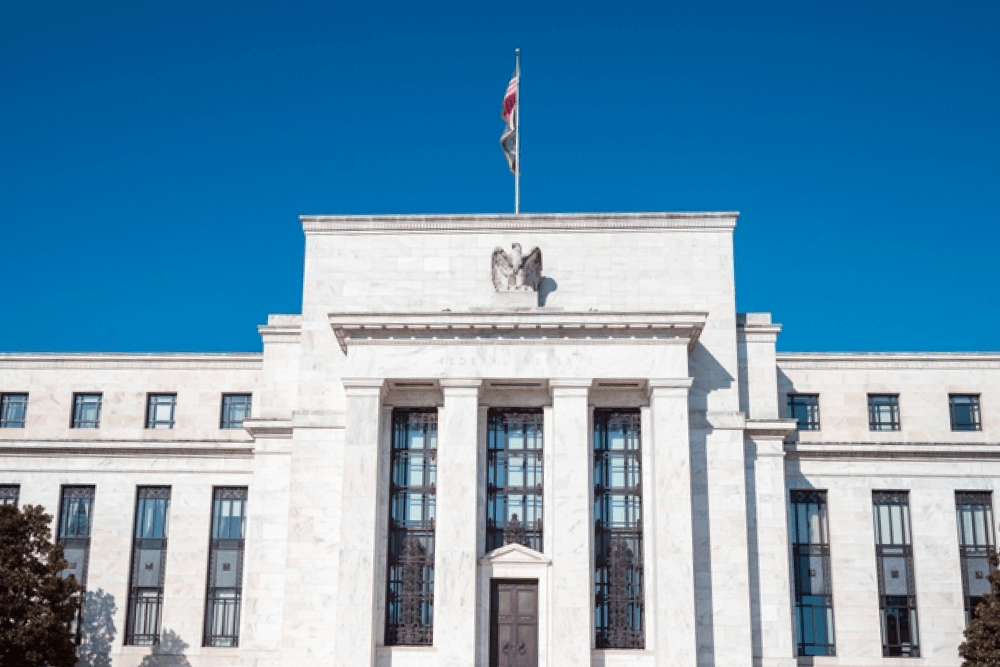
The Federal Reserve held the benchmark short-term interest rate steady, in the range of 3.50% to 3.75% in March. The decision gives the Federal Open Market Committee (FOMC) more time to assess increasing risks on both sides of its dual statutory mandate to promote price stability and foster full employment. This pause also allows the Fed to monitor the impact of the ongoing war in the Middle East on the global energy markets and ultimately the U.S. economy according to Value Line. The gross domestic product (GDP) slowed to an estimated advance of just 0.7% in the final quarter of 2025.
Inflation is running above the central bank’s comfort level. The Personal Consumption Expenditures (PCE) Price Index, which measures changes in average prices of a wide range of everyday goods and services purchased by U.S. individuals, increased in January. Specifically, the PCE and “core” PCE, which excludes food and energy, rose 0.3% and 0.4%, respectively, on a month-to-month basis. From a one-year perspective, the PCE and core PCE increased 2.8% and 3.1%, respectively. These increases in the inflation measure trusted most by Federal Reserve officials were still notably above the Fed’s target rate of 2.0%. The readings also were taken ahead of the recent jump in global oil prices, which will likely put additional upward pressure on prices at both the producer and consumer levels. This makes the Fed’s task of reining in inflation more difficult. U.S. Treasury note yields rose on this concern.
Meanwhile, the labor market has shown signs of weakness. The Labor Department reported that the nation lost an estimated 91,000 jobs in February. The report also showed an uptick in the unemployment rate and a sharp drop in the labor force participation rate, which indicates some slack in the labor market. On the positive side, initial weekly unemployment claims remain quite contained, and the Job Openings and Labor Turnover Survey (JOLTS) showed that U.S. job openings rose to 6.946 million in January of 2026, rebounding from a five-year low in December.
Global economy
The Middle East conflict is entering a more dangerous macroeconomic phase according to JP Morgan (JPM). March saw attacks on energy infrastructure that raised the specter of broader and more lasting supply disruptions. Although crude oil and natural gas prices have moved higher, they remain well below levels consistent with a sustained disruption of the current magnitude. While balancing the growth drag from higher prices with economic data showing stronger-than-expected global growth, the rising concern is that the energy supply shock will be magnified through some combination of building price increases, quantity constraints, and tightening financial conditions.
JPM’s model estimates suggest that a supply shock that keeps energy prices close to $100bbl through midyear (moderating towards $80bbl thereafter) would raise consumer prices roughly 0.8%pt this year. The global GDP drag associated with this shock is estimated at 0.6%pt. Offsetting this drag is the impressive growth momentum at the start of the year. On balance, JPM’s 2026 forecast revisions have lowered GDP by only 0.2%pt so far.
JPM has raised its 1Q26 global GDP forecast to 3.4% annual rate (ar), a full percentage point above potential, on the back of upward revisions in the US (3.3%ar) and China (7.2%ar). Underlying these upward revisions is the recent acceleration in JPM’s capex forecast which is tracking a 7.2%ar current quarter gain, led by still buoyant tech demand. The initial March set of US regional surveys sent a constructive message on activity and business expectations.
The global economy has displayed impressive resilience during this expansion as it has absorbed multiple shocks. Some key cushions — healthy private sector balance sheets and the delivery of timely fiscal support — remain in place. Global fiscal policy is already set to ease this year, with notable stimulus in the US, China, and Germany. Recent fiscal actions to limit energy pass-through to consumers will add to this impulse. The US and other countries that are net energy exporters are less vulnerable to potential quantity constraints related to a prolonged shortfall in Middle East energy supply as well. Asia is the most exposed, and petro-chemical plants are starting to cut back output and governments implement demand management measures. The potential damage related to quantity constraints in Asia is large, but regional governments have stockpiled crude buffers. JPM highlights that a bigger vulnerability is gas availability, given its importance in North Asia, but here, plans are in place that can offset supply disruptions for one-to-two months.
Stock market
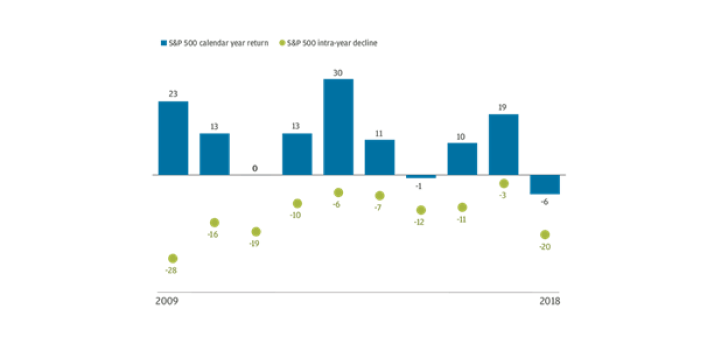
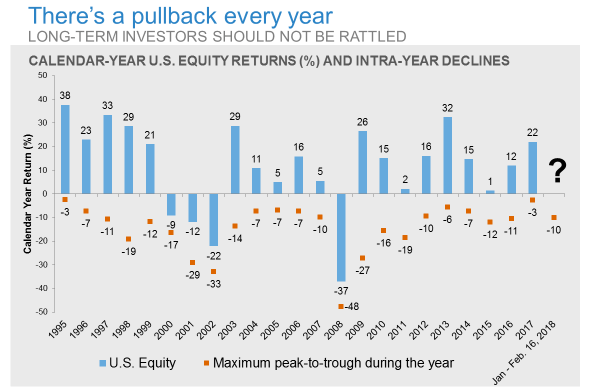
The stock market got softer over the last few weeks, but Professor Siegel remains optimistic:
“My base case is straightforward. The Fed does nothing at the next meeting. After that, the path of rates depends much more on oil than on anything in the current dot plot. If crude stabilizes and tariff effects begin to roll off in the middle of the year, the Fed still has room to cut later in 2026. If the energy shock intensifies and inflation expectations move materially higher, those cuts will be delayed. That is one reason why the long bond has been under pressure. The market is demanding a higher term premium because geopolitical risk and more defense spending, fiscal anxiety, and energy inflation are all hitting at once. The important point is that yields are responding to oil and uncertainty, not to a materially more hawkish Federal Reserve.
For investors, that distinction is crucial. An oil shock can absolutely produce a correction, and it will hit cyclicals and disposable-income-sensitive groups first. But a correction is not a collapse. If the Middle East risk premium eases, this market can turn very quickly back to earnings and productivity, and from the March 20 close near 6,508 I would expect the S&P 500 to work back toward 6,900 to 7,000 before year-end.
I would not chase the energy spike. I would continue to favor high-quality equities over long-duration bonds and use volatility to add to productivity beneficiaries, select technology, and dividend growers. International markets have been interrupted more than invalidated; a stronger dollar and higher oil are temporary headwinds, and a de-escalation would reopen the valuation case in Europe, Japan, and emerging markets, while the global defense-tech cycle remains a longer-run tailwind for innovative new technologies outside the U.S.
The bottom line is simple. This was a constructive Fed meeting disguised by an ugly geopolitical tape. The Committee acknowledged stronger trend growth, kept its basic easing bias alive, and implicitly recognized that the U.S. economy is more productive than it thought three months ago. The near-term problem is oil. The longer-term story is productivity. I am not dismissing the risk of a correction, but I remain optimistic because growth, earnings, and AI driven efficiency are more durable forces than a temporary shock in energy markets.”
The information and opinions included in this document are for background purposes only, are not intended to be full or complete, and should not be viewed as an indication of future results. The information sources used in this letter are: WSJ.com, Jeremy Siegel, Ph.D. (Jeremysiegel.com), Goldman Sachs, J.P. Morgan, Empirical Research Partners, Value Line, BlackRock, Ned Davis Research, First Trust, Citi research, HSBC, and Nuveen.
IMPORTANT DISCLOSURE
Past performance may not be indicative of future results.
Different types of investments and investment strategies involve varying degrees of risk, and there can be no assurance that their future performance will be profitable, equal to any corresponding indicated historical performance level(s), be suitable for your portfolio or individual situation, or prove successful.
The statements made in this newsletter are, to the best of our ability and knowledge, accurate as of the date they were originally made. But due to various factors, including changing market conditions and/or applicable laws, the content may in the future no longer be reflective of current opinions or positions.
Any forward-looking statements, information, and opinions including descriptions of anticipated market changes and expectations of future activity contained in this newsletter are based upon reasonable estimates and assumptions. However, they are inherently uncertain, and actual events or results may differ materially from those reflected in the newsletter.
Nothing in this newsletter serves as the receipt of, or as a substitute for, personalized investment advice. Please remember to contact Signet Financial Management, LLC, if there are any changes in your personal or financial situation or investment objectives for the purpose of reviewing our previous recommendations and/or services. No portion of the newsletter content should be construed as legal, tax, or accounting advice.
A copy of Signet Financial Management, LLC’s current written disclosure statements discussing our advisory services, fees, investment advisory personnel, and operations are available upon request.
Investment advisory and financial planning services offered through Summit Financial, LLC., a SEC-Registered Investment Adviser, doing business as Signet Financial Management. The views and opinions expressed in this newsletter are solely those of the author and should not be attributed to Summit Financial, LLC., a SEC Registered Investment Adviser.