The primary driver of the 2026 market is corporate earnings growth, yet the path to capturing that growth feels less like a steady climb and more like a high-speed slalom. While sudden selloffs and geopolitical tension create a sense of high-speed complexity, strategic discipline remains the most effective tool for navigating this volatility.
The four pillars of influence
Four primary forces are currently driving global market sentiment in diverging directions:
- Earnings momentum: Corporate performance remains a primary driver of recent equity strength.
- The AI supercycle: Technological innovation continues to influence both corporate earnings and price action across multiple sectors.
- Domestic politics: Fiscal policies and upcoming midterm election cycles are contributing to increased market volatility.
- Geopolitics: Persistent regional tensions continue to impact global trade flows and investor sentiment.
Speculation vs. long-term investment
In periods of rapid change, the temptation to react to the daily news cycle increases. However, short-term speculation often carries heightened risk in volatile climates. While Q1 earnings contributed to market momentum, investors should note that market breadth — the number of individual stocks participating in the rally — remains concentrated.
The strategy: By extending your time horizon and focusing on structural shifts rather than near-term gyrations, the path forward becomes clearer. A long-term perspective allows investors to navigate volatility while seeking to capture potential upside from fundamental growth.
Assessing market skepticism
With markets near historical highs, some investors are concerned that certain risks are being overlooked. However, data suggests the recent rally is anchored by fundamental earnings growth. According to recent analysis from Goldman Sachs, earnings forecasts for 2026 and 2027 have risen at a faster pace than equity prices. Interestingly, despite the headline gains, the current P/E (Price-to-Earnings) multiple is actually lower today than it was in January. This suggests that the market’s appreciation is being driven by corporate profitability rather than pure multiple expansion.
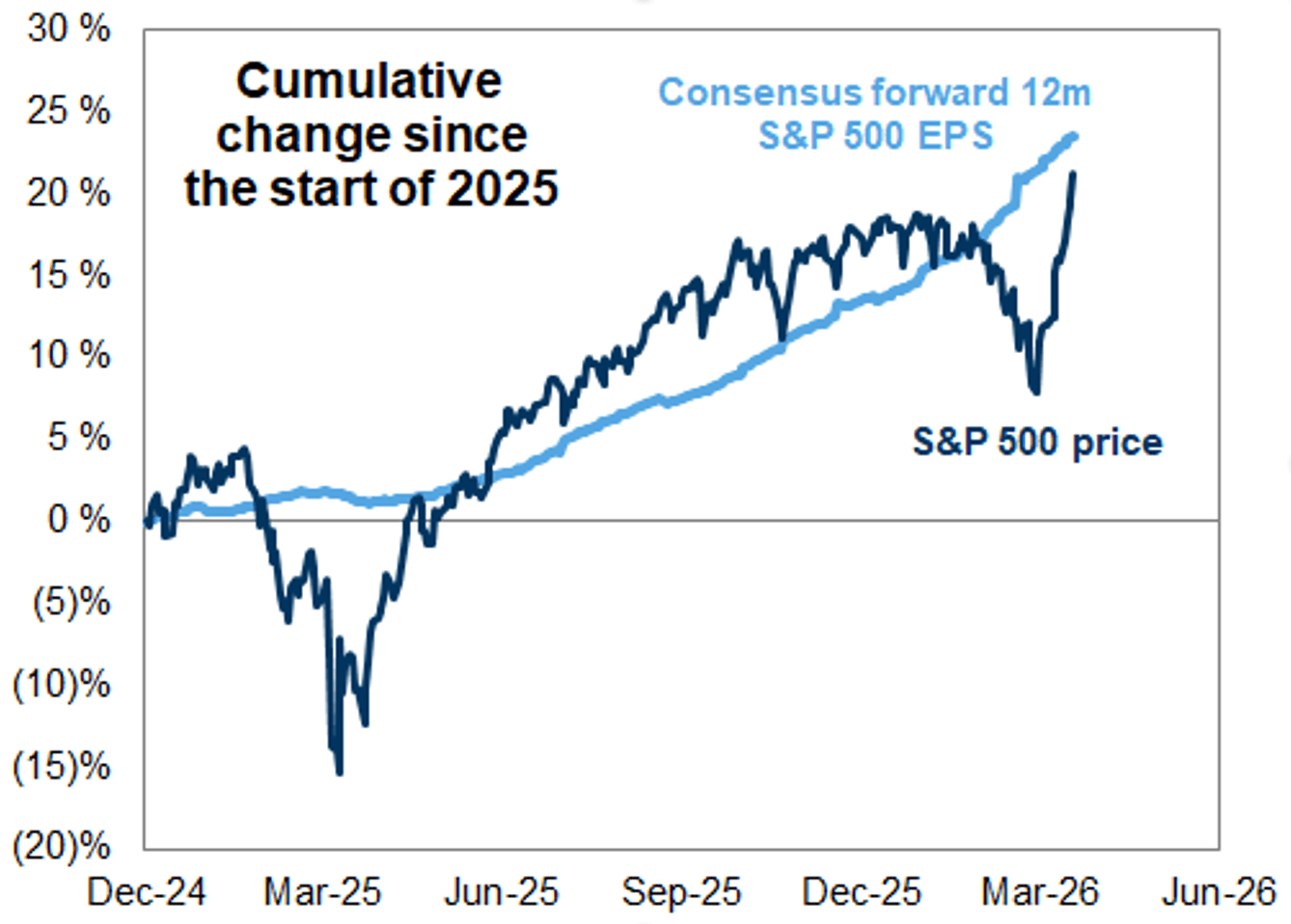
While history suggests that earnings are a primary driver of stock performance over the long term, it is important to remember that past performance is not indicative of future results. While many forecasts are trending higher, diversification remains essential, as no strategy can guarantee a profit or protect against loss.
Notable headwinds: Energy and interest rates
Two specific factors are currently testing market momentum:
- The energy factor: Potential upside risks for oil prices remain, particularly as the Strait of Hormuz serves as a critical choke point for global supply chains. Sustained higher energy costs could impact corporate margins.
- Monetary policy: Interest rates are expected to remain elevated as the Federal Reserve continues to prioritize inflation management over immediate rate reductions.
The bottom line
Investing is rarely a linear path. Following a volatile start to the year, recent market resilience has demonstrated that equities can thrive when supported by strong fundamentals. We encourage investors to remain focused on long-term themes and earnings data rather than short-term market noise.
IMPORTANT DISCLOSURE
The statements made in this newsletter are, to the best of our ability and knowledge, accurate as of the date they were originally made. But due to various factors, including changing market conditions and/or applicable laws, the content may in the future no longer be reflective of current opinions or positions.
Any forward-looking statements, information and opinions including descriptions of anticipated market changes and expectations of future activity contained in this newsletter are based upon reasonable estimates and assumptions. However, they are inherently uncertain and actual events or results may differ materially from those reflected in the newsletter.
Nothing in this newsletter serves as the receipt of, or as a substitute for, personalized investment advice. Please remember to contact Signet Financial Management, LLC, if there are any changes in your personal or financial situation or investment objectives for the purpose of reviewing our previous recommendations and/or services. No portion of the newsletter content should be construed as legal, tax, or accounting advice. The views and opinions expressed in this report are solely those of the author and should not be attributed to Summit Financial, LLC., a SEC Registered Investment Adviser.