US economics, inflation, jobs and the Fed
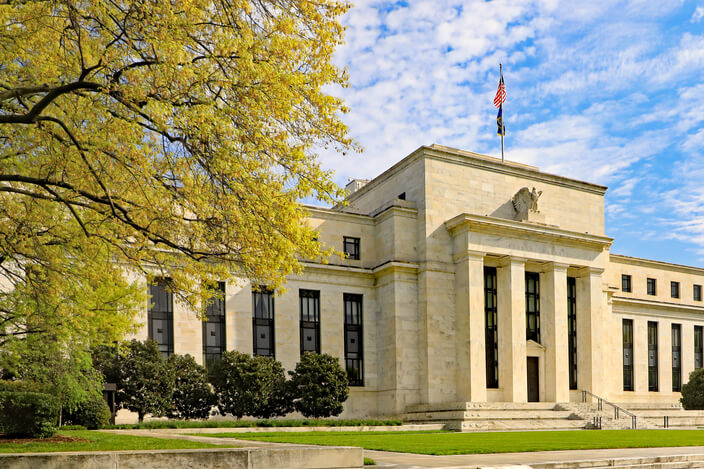
In the last few days of August short-term Treasury yields moved higher as Fed Сhairman Kevin Warsh’s comments were taken as a sign that interest rates could rise. He spoke at the Kansas City Fed’s annual conference in Jackson Hole, Wyoming. He signaled the central bank may not be done fighting inflation, a stance that could play a big role in where Treasury yields and stock prices head next.
Inflation, rather than the jobs situation, remains a bigger concern for the Fed according to Value Line. However, the July inflation data, along with the decline in wage growth, does allow the central bank to take a wait-and-see approach regarding the Fed interest rate. On the heels of a more benign July Consumer Price Index (CPI) reading, the companion Labor Department report showed an easing in the pace of price growth at the wholesale level. Specifically, the Producer Price Index (PPI) was unchanged on a month-to-month basis, while the core PPI, which excludes food and energy, increased 0.2%. Both figures came in below forecast. The 12-month PPI increase of 4.7% was down from the 5.5% advance recorded in June. In the meantime, the fixed-income market is potentially cooling economic activity, with the 30-year Treasury bond yield recently topping 5.30%, its highest level since 2007.
The central bank also may be worried that an interest-rate hike to slow inflation would hurt an economy that has recently shown signs of softness. The gross domestic product (GDP) increased by an estimated annualized rate of 1.5% in the second quarter, which was below forecast. There are some definite weak spots that have been offset by the impact of astronomical spending on artificial intelligence (AI) infrastructure. The housing market is still suffering from higher mortgage rates, while the positive impact from larger tax refunds is expected to dissipate during the second half of the year. On point, retail sales fell by an unexpected 0.2% on a month-to-month basis in July, the worst showing since early 2025 according to Value Line.
Global economy
Since the COVID inflation shock, a “high-for-long” interest rate view has been a key tenet of JP Morgan’s (JPM) macroeconomic narrative. Expectations for inflation to remain at uncomfortably sticky levels have been a central feature of a view that central bank policy rates would not return to pre-COVID levels before the next global recession. But JPM’s narrative also incorporated a shift upward in both short and longer rates for reasons beyond sticky inflation. Understanding these forces is important for gauging the trajectory of financial conditions and expansion.
At the short end, JPM argued for a resilient expansion in the face of the synchronized global hiking cycle in 2022-2024, as neutral real rates were higher than many expected in response to strong cyclical fundamentals. Relative to the post-Great Financial Crisis expansion, healthy balance sheets and supportive credit conditions pointed to stronger and more resilient private sector demand. These mid-cycle fundamentals meant that high rates were not drivers of late-cycle developments but rather a product of cyclical strength. At the same time, the fiscal response to a series of supply shocks and political pressures has raised the path of public sector debt and deficits, while the AI technology shock has raised the demand for capital. In response, long-yields have incorporated this shift despite market pricing for policy rates to return towards pre-COVID norms following a sharp 2022-23 global tightening cycle — thus steepening the curve.
Against this backdrop, the rise in interest rates this year can be connected to market disappointment for an immaculate disinflation and the resulting swing from expected cuts to hikes. Notwithstanding the disappointments in July activity, this repricing is reinforced by the latest survey data for August, including the most recent flash Purchasing Managers Indexes (PMIs) showing the expansion tracking JPM’s call for a cyclical lift. JPM expects a series of hikes before year-end, from seven of the nine DM central banks JPM follows.
Alongside rising policy rate expectations, the increase in yields also reflects two other developments:
- Fiscal keeps easing. While some fiscal easing had been built into JPM 2026 forecast (German defense and infrastructure spending, US tax cuts, China front-loading), greater action has been delivered around the world. Three forces are at work. First, the fiscal support to cushion the drag on consumer purchasing power from this year’s energy shock. Second, a broad turn towards easing in Asia, as revenue generated from the tech sector boom pressures governments to address the expansion’s imbalances. Third, the US’s increased defense spending and reduced tariffs have led to a greater net fiscal deficit. This week the CBO revised its current fiscal year federal government deficit up by $200bn, pointing to a deficit that will remain close to 6.5% of GDP.
- The credit cycle kicks in. Despite strong profits, credit growth is booming. This partly reflects demand from large tech companies building out AI. JPM credit team sees $400bn in new AI-related credit this year, more than double the 2024 pace. But a broader acceleration in Developed Markets (DM) bank credit is taking hold, which JPM believes aligns with the rebound in business non-tech spending.
Stock market
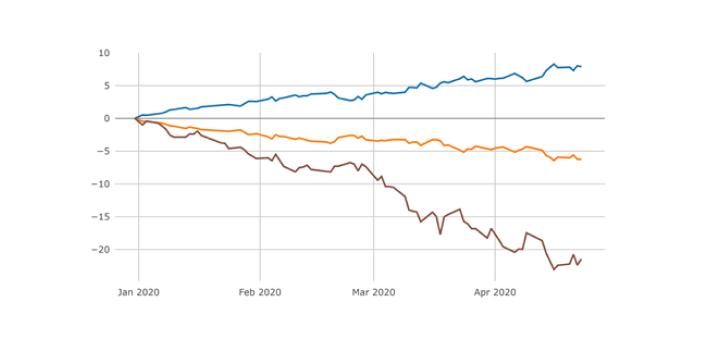
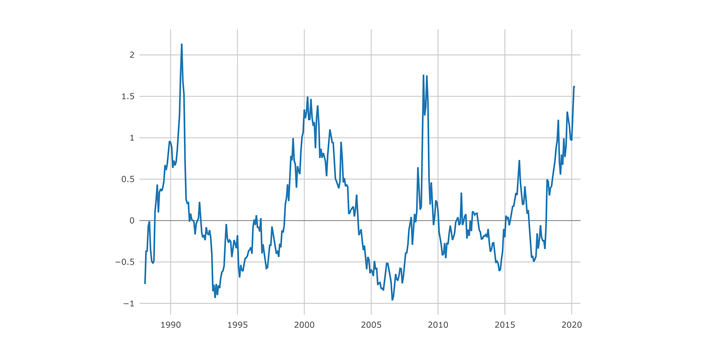
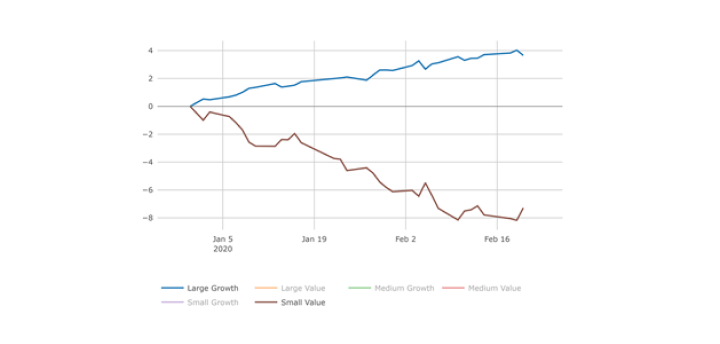
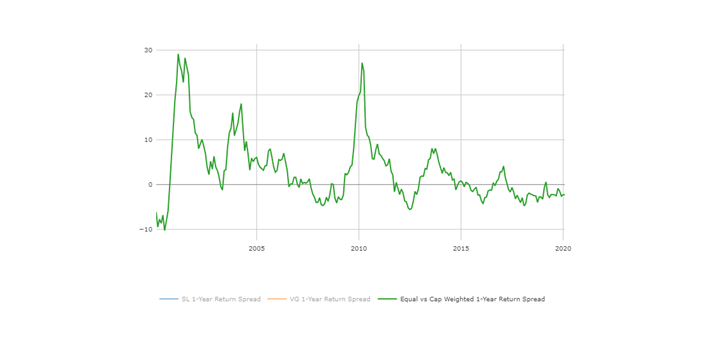
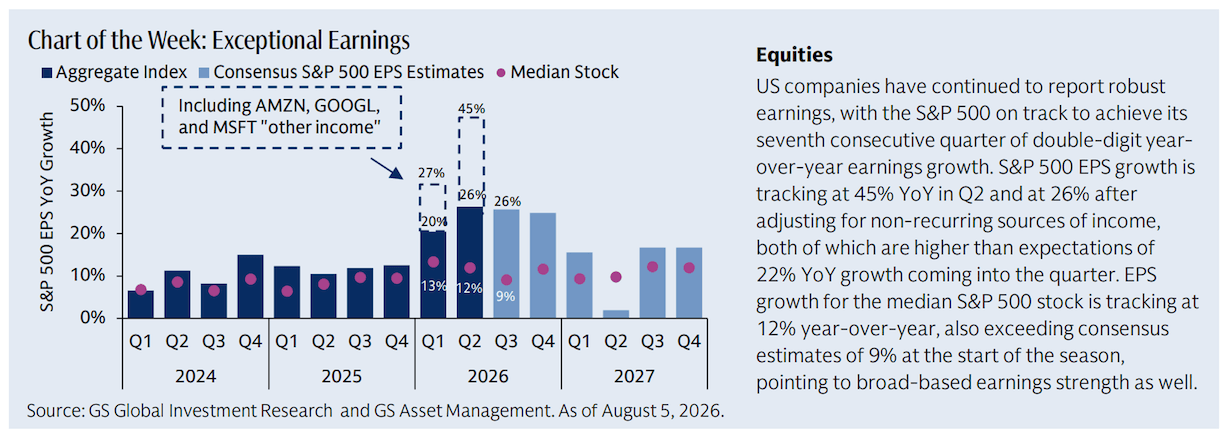
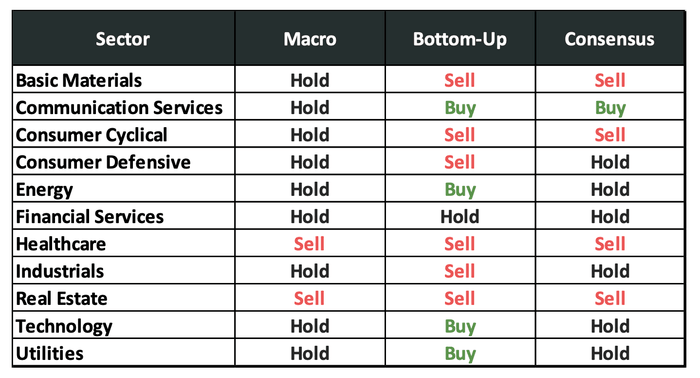
While the stock market reacted negatively to the rise in long-term interest rates, Corporate America finished the second quarter of 2026 profitable. However, the AI super-charge of those earnings remains a concern (see Chart from Goldman Sachs below). We recently rebalanced our actively managed proprietary individual equity strategies at Signet. As you can see from our Economic Sector Forecast below the current reading favors Communications, Energy, Technology and Utilities — a combination of traditionally defensive and cyclical sectors. To balance the over-reliance on the AI theme, we added to Financials which may benefit from rising long-term interest rates and are not as dependent on AI as other sectors. We will continue meaningfully diversifying our portfolios to help hedge against potential repricing in the market down the road.
Signet’s economic sectors forecast – next 12 months
The information and opinions included in this document are for background purposes only, are not intended to be full or complete, and should not be viewed as an indication of future results. The information sources used in this letter are: WSJ.com, Jeremy Siegel, Ph.D. (Jeremysiegel.com), Goldman Sachs, J.P. Morgan, Empirical Research Partners, Value Line, BlackRock, Ned Davis Research, First Trust, Citi research, HSBC, and Nuveen.
IMPORTANT DISCLOSURE
Past performance may not be indicative of future results. Indexes are unmanaged and investors cannot invest directly in an index. Diversification does not assure a profit or protect against loss.
Different types of investments and investment strategies involve varying degrees of risk, and there can be no assurance that their future performance will be profitable, equal to any corresponding indicated historical performance level(s), be suitable for your portfolio or individual situation, or prove successful.
The statements made in this newsletter are, to the best of our ability and knowledge, accurate as of the date they were originally made. But due to various factors, including changing market conditions and/or applicable laws, the content may in the future no longer be reflective of current opinions or positions.
Any forward-looking statements, information, and opinions including descriptions of anticipated market changes and expectations of future activity contained in this newsletter are based upon reasonable estimates and assumptions. However, they are inherently uncertain, and actual events or results may differ materially from those reflected in the newsletter.
Nothing in this newsletter serves as the receipt of, or as a substitute for, personalized investment advice. Please remember to contact Signet Financial Management, LLC, if there are any changes in your personal or financial situation or investment objectives for the purpose of reviewing our previous recommendations and/or services. No portion of the newsletter content should be construed as legal, tax, or accounting advice.
A copy of Signet Financial Management, LLC’s current written disclosure statements discussing our advisory services, fees, investment advisory personnel, and operations are available upon request.
Investment advisory and financial planning services offered through Summit Financial, LLC., a SEC-Registered Investment Adviser, doing business as Signet Financial Management. The views and opinions expressed in this newsletter are solely those of the author and should not be attributed to Summit Financial, LLC., a SEC Registered Investment Adviser.