
Something unusual is happening in the financial markets, and many investors are feeling friction. Long-term bond yields recently climbed to their highest levels in nearly two decades, with the 30-year U.S. Treasury yield touching 5.3%. What is driving this shift, and how should it change the way you think about your money?
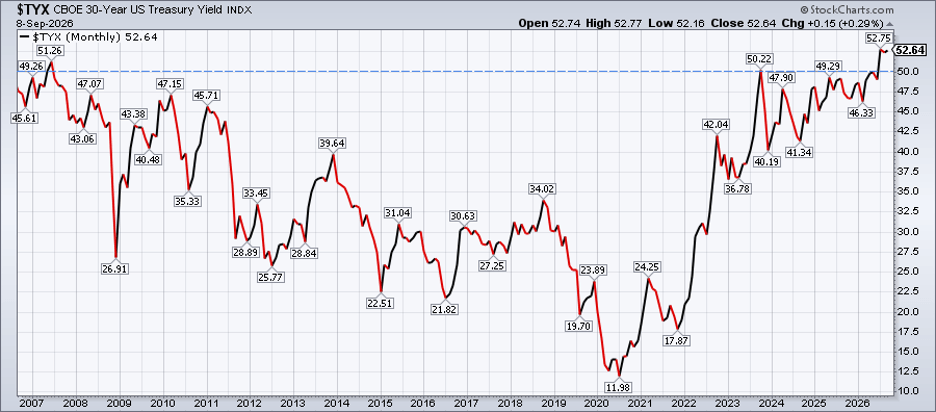
Why yields are climbing
Long-term rates are rising for several reasons, including a mix of heavy corporate borrowing, elevated federal debt issuance, and inflation uncertainty.
- Corporate borrowing pressures: The artificial intelligence buildout is consuming cash at a rapid pace as tech companies turn to the bond market to fund large-scale infrastructure builds.
- Government debt and deficits: The U.S. government is borrowing at levels well above the past decade, significantly increasing net Treasury issuance. As the national debt grows, investors are demanding higher returns to finance it.
- A global ripple effect: This is not just a U.S. story. Countries worldwide are seeing yields climb as they adjust their borrowing to the short end of the curve, waiting for rate cuts that may take longer to arrive than anticipated.
Meanwhile, the Federal Reserve is navigating mixed signals. Main Street is showing signs of cooling — with softer job numbers and slower retail spending — while parts of industry remain resilient. Because of these conflicting trends, the timing and path of future interest rate cuts remain uncertain.
How to navigate your portfolio
When the rules of the market change, your portfolio should not stand still. Here is how we help clients navigate shifting market environments:
- Keep bond maturities flexible: With heavy debt pressuring long-term rates, holding long-term bonds can introduce unnecessary price volatility and interest rate risk. We favor owning shorter maturities and focusing on active credit management to seek yield and manage downside risk. (Note: Bond and credit strategies carry inherent risks, including credit/default risk, spread widening, and potential loss of principal.)
- Add inflation protection: Swapping a portion of standard bonds for Treasury Inflation-Protected Securities (TIPS) can provide a potential buffer against inflation, though TIPS values still fluctuate with real interest rates.
- Focus on strong balance sheets: As heavy tech spending faces a reality check, companies with strong cash flow and solid fundamentals tend to weather tightening credit conditions better than speculative plays reliant on cheap debt.
- Use real assets as a potential diversifier: In an era of heavy national deficits and unpredictable headlines, holding tangible assets like real estate, gold, and commodities can help diversify portfolios. (Note: Real assets are not guaranteed to protect against currency pressures and involve trade-offs such as commodity price volatility, real estate illiquidity, leverage risks, and roll costs.)
- Keep some cash ready: Utilizing short-term bonds and Treasury bills allows investors to access current yields, though investors should note that yields are variable and can decline. Short-term instruments also carry reinvestment risk and the possibility that returns may lag inflation over time.
Markets are rarely boring, and navigating this environment takes discipline rather than guesswork.
How are your current investments holding up in this higher-rate environment? Reach out to your Signet advisor for a risk assessment. It is a straightforward way to evaluate whether your portfolio is positioned for higher rates.
Disclosures and disclaimers
Past performance is no guarantee of future results. No statement in this article should be construed as specific tax, legal, or personalized investment advice. Different types of investments involve varying degrees of risk, and there can be no assurance that any specific investment or strategy will be suitable or profitable for a client’s portfolio.
Investment advisory and financial planning services offered through Summit Financial, LLC, an SEC Registered Investment Advisor, doing business as Signet Financial Management.